 Base
Base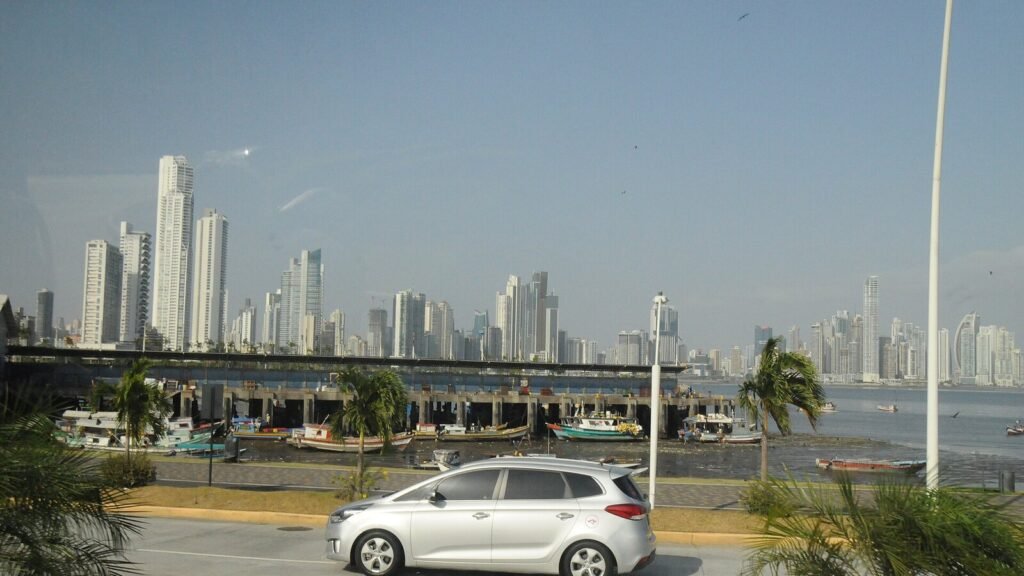
Last verified: August 18, 2026. Every source is linked in the tables.
Before you decide to move, invest, or open a business in a country, look at ten years of its numbers — not the highlight reel of one good year. We’ve gathered Panama’s official series on inflation, growth, interest rates, and population, with a source on every figure, plus the comparisons that put them in perspective. This is Part 1; Part 2 turns it all into real prices: rents, neighborhoods, and services.
Inflation: a decade with almost none
| Year | Inflation (% p.a.) | Year | Inflation (% p.a.) |
|---|---|---|---|
| 2016 | 0.7% | 2021 | 1.6% |
| 2017 | 0.9% | 2022 | 2.9% |
| 2018 | 0.8% | 2023 | 1.5% |
| 2019 | −0.4% | 2024 | 0.7% |
| 2020 | −1.6% | 2025 | −0.2% |
Source: World Bank (CPI series from Panama’s INEC/Comptroller General).
Read that table twice, because it is the country in summary: in ten years, inflation never exceeded 2.9% a year — not even in 2022, when the whole world was burning. The decade’s average was about 0.7% a year, with three years of mild deflation. The ten-year cumulative total is roughly 7%. In the United States over the same stretch, prices rose by more than a third. The IMF noted in 2025 that Panama has the lowest inflation in Latin America.
That’s not luck — it’s architecture. Panama has been fully dollarized since 1904. The balboa is pegged 1:1 and the US dollar circulates as legal tender. There is no money-printing central bank, so there is no printing money to plug fiscal holes. The only inflation here is whatever arrives imported in the containers.
Growth: a pandemic roller coaster, a strong engine after
| Year | GDP (%) | Year | GDP (%) |
|---|---|---|---|
| 2016 | +4.6% | 2021 | +16.5% |
| 2017 | +5.7% | 2022 | +11.0% |
| 2018 | +3.9% | 2023 | +7.2% |
| 2019 | +3.1% | 2024 | +2.8% |
| 2020 | −17.8% | 2025 | +4.4% |
Sources: World Bank; 2025 confirmed by the Comptroller General. The IMF projects ~4% for 2026.
Two numbers jump out. The −17.8% collapse in 2020 — one of the world’s steepest, the price of one of the longest, strictest lockdowns anywhere — and the +16.5% rebound right after. Set the pandemic hiccup aside and the country has grown 4–5% a year for a decade, well above the Latin American average.
What drives it: the Panama Canal, which in 2025 delivered US$2.96 billion straight to the Treasury (daily transits recovered from 25 to 33 ships after the 2024 drought, and transport & logistics grew 14.5%); the Colón Free Zone, the largest free-trade zone in the Americas; the international banking center; the Tocumen air hub; and a robust public-works pipeline the IMF flags as 2026’s engine.
Interest rates: familiar numbers, in dollars, with no currency risk
| Credit line | Average rate (Oct 2025) |
|---|---|
| Mortgage (no subsidy) | 6.24% p.a. |
| Mortgage with interés preferencial (new home up to US$120k) | 2.5% to 4.0% p.a. |
| Car loan | 7.94% p.a. (new cars from 6.0–7.25%) |
| Personal loan | 8.92% p.a. (from 8.5%) |
| Business / SME credit (machinery, working capital) | ~6.5% to 10% p.a. (+1% FECI levy) |
| Credit card | 22% p.a. |
Sources: system averages from the Superintendency of Banks (via La Prensa, Oct 2025); Banco General’s published rates (Feb 2026); Law 468/2025 (subsidized mortgage program).
For an American reader the headline mortgage rate looks familiar — around 6–7.5%, close to a US 30-year. The differences are in the fine print: terms up to 30 years financing up to 98% of the property, and a state program (Law 468/2025) that subsidizes new homes under US$120k down to 2.5–4% a year — Banco General’s February 2026 sheet shows 2.50% on the US$45–80k bracket. For readers coming from Brazil or Colombia, where mortgages rarely dip below 10–11% in a depreciating currency, this is the single most life-changing table in this article. One more detail any business owner will appreciate: credit cards here charge 22% a year — in several neighboring countries that’s a quarterly figure.
Direction of travel: the banking superintendent expects rates to ease more clearly only in late 2026, once banks’ time deposits reprice downward.
Who lives here: 4.2 million — including 250,000 foreigners
The 2023 Census (INEC) counted 4,202,572 people. The real “city” — Panama district (1,086,990) plus San Miguelito (280,277) — comes to ~1.37 million; the wider metro area, including Panamá Oeste (Arraiján, La Chorrera), reaches ~2.1 million: half the country within a 25-mile radius. Panamá Oeste grew 50.6% in 13 years — that’s where the capital is spilling over. Within the capital, San Francisco was the fastest-growing district, while the historic center lost 15% of its residents.
| Country of origin | Residents (2023 Census) |
|---|---|
| Colombia | 66,234 |
| Venezuela | 59,909 |
| Nicaragua | 30,585 |
| China | 14,099 |
| Dominican Republic | 8,800 |
| Total foreign-born | 249,201 (6.1% of the population) |
Source: INEC, 2023 Census. Brazilians: ~3,540 residents (Brazil’s Foreign Ministry, 2023). US citizens were among the top ten, with 1,569 new residencies approved in 2024 alone.
Two out of three foreigners live in the capital, where they already make up 12.5% of the population — which is why some neighborhoods run in “international mode” (and charge accordingly, as we show in Part 2). The flow continues: through September 2024, immigration approved 37,891 residence permits — Colombia and Venezuela in front, the US with 1,569, China with 1,504. The most-used routes are in our residency visa comparison.
The part nobody tells you
- Deflation has a flip side. Flat prices are great for your wallet, but they’re also a symptom of lukewarm consumption. The copper mine — once worth ~5% of GDP — has been closed since 2023, and Fitch pulled its investment-grade rating in 2024 (Moody’s and S&P still hold theirs; the deficit fell from 7.4% to ~4% of GDP in 2025 and Fitch acknowledged the target was met).
- Local purchasing power is thin. The median salary in the capital hovers around US$776/month. That means affordable labor if you’re building a business — but if you sell to the domestic market, you’re selling to a narrow pyramid, propped up by foreigners.
- Low rates ≠ easy credit. Panamanian banks are conservative: they verify income, ask for history, and take weeks. The rates are first-world; the paperwork is that of a bank that hates being wrong.
The honest verdict
If what you want is predictability — keeping wealth in dollars, borrowing cheap, signing contracts inflation can’t melt — Panama delivers a combination that is rare in Latin America: a decade of near-zero inflation, growth above the regional average, and mortgage credit most of its neighbors simply cannot offer. What it is not: a huge consumer market. If you’re coming to build a business, aim at the right audience — and if you’re coming to live, know what each neighborhood really costs. That’s exactly what we open up in Part 2: rents, neighborhoods, services, and the price contrasts we live with every day.
Cover photo: David Broad, Wikimedia Commons (CC BY 3.0).